Mackintosh and the Equine Form
Art Nouveau's Enduring Influence

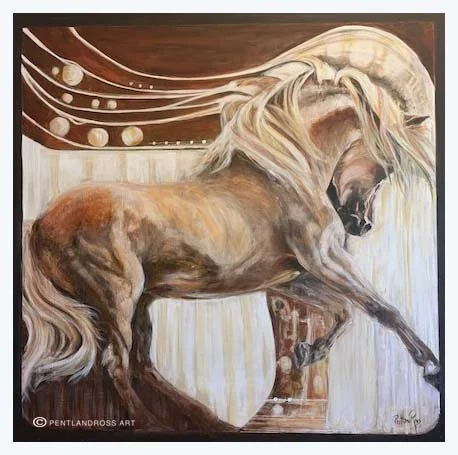
Spirit of Glasgow, oil on canvas. Celebrating Charles Rennie Mackintosh's design legacy through classical equine form. Limited edition available
Charles Rennie Mackintosh never painted horses. His genius expressed itself through architecture, furniture, and the stylized roses that became his signature. Yet when I created "Spirit of Glasgow," it was Mackintosh's visual language, those distinctive flowing lines, the organic curves, the marriage of structure and decoration that provided the framework for exploring equine form through an Art Nouveau lens.
Glasgow's Design Legacy
Glasgow at the turn of the twentieth century was a city of remarkable creative energy. While continental Europe developed Art Nouveau, Glasgow created its own distinctive variant, the Glasgow Style. Mackintosh, alongside the "Glasgow Four" (Margaret Macdonald, Frances Macdonald, and Herbert McNair), developed an aesthetic that was at once international and distinctly Scottish: elegant without being precious, structured without being rigid, decorative without sacrificing function.
Mackintosh's influence on Scottish design cannot be overstated. From the Glasgow School of Art to the Willow Tea Rooms, his work established a visual vocabulary that remains instantly recognizable more than a century later. Those elongated forms, the interplay of straight lines and organic curves, the restrained color palette punctuated by moments of vivid accent, these elements have become synonymous with a certain strand of Scottish artistic identity.
Translating Architecture into Equine Art
The challenge in creating "Spirit of Glasgow" was not merely to apply Mackintosh's decorative motifs to a horse painting any competent illustrator could manage that. The deeper question was how to translate his design principles into classical painting technique while maintaining both the integrity of equine anatomy and the sophistication of his aesthetic vision.
Mackintosh's genius lay in his understanding of line. His architectural drawings demonstrate an almost calligraphic quality, where structure and ornament become inseparable. In "Spirit of Glasgow," the horse's mane becomes an exploration of this linear quality flowing lines that suggest both natural movement and Art Nouveau's characteristic whiplash curves. The composition balances the solid, three dimensional presence of the equine form against the more stylized, decorative treatment of secondary elements.
This approach required careful negotiation. Too literal an interpretation of Mackintosh's style risks pastiche. Too subtle, and the homage becomes invisible. The goal was to create a work that functions simultaneously as classical equine portraiture and as a genuine engagement with Glasgow Style design principles.
Classical Technique, Contemporary Vision
What makes Mackintosh's work enduringly relevant is its refusal to choose between tradition and innovation. His buildings are deeply functional while being visually striking. His furniture serves practical needs while achieving sculptural presence. This both and quality, rather than either or, offers a model for contemporary artistic practice.
In equine art, there's sometimes an unfortunate divide between classical technique and contemporary vision as if one must choose between historical fidelity and modern relevance. Yet the most compelling work, historically and today, exists in dialogue between these approaches. Stubbs painted horses with anatomical precision while developing distinctly modern compositional strategies. Degas brought classical training to radically contemporary subject matter.
"Spirit of Glasgow" attempts to honor this tradition of synthesis. Classical oil technique provides the foundation the careful building of form, the attention to light and volume, the patient layering of paint. But the vision is contemporary, drawing on Scotland's design heritage to create something that speaks to present-day collectors while remaining grounded in craft and tradition.
Why Mackintosh Matters for Today's Collectors
For collectors of contemporary Scottish art, Mackintosh represents more than historical interest. His work embodies a particular kind of Scottish sophistication intellectual without being academic, innovative without being trendy, rooted in place while remaining internationally relevant. These are precisely the qualities that distinguish serious collecting from mere decoration.
When collectors acquire "Spirit of Glasgow," they're participating in an ongoing cultural conversation about Scottish identity and artistic heritage. The piece connects to Glasgow's design legacy while demonstrating how historical influence can inform contemporary practice without becoming mere reproduction. It's a work that rewards sustained attention, revealing its layers of reference and technique over time.
Mackintosh once wrote, "There is hope in honest error; none in the icy perfections of the mere stylist." In that spirit, "Spirit of Glasgow" aspires not to perfect replication of his aesthetic, but to honest engagement with his design principles translated through equine form and classical painting technique. It's an homage that honors tradition while insisting on contemporary relevance much like Mackintosh's own practice more than a century ago.
"Spirit of Glasgow (Charles Rennie Mackintosh)" is available as a limited edition archival print, strictly limited to 25 examples worldwide. Each print is individually signed, numbered, and accompanied by a certificate of authenticity.